

PREUSE
Public Responses to Enable the Use of Salvaged building Elements – Interreg NWE project
View more


Promote the preservation of resources and the reuse of salvaged construction material in Luxembourg through preventive actions.
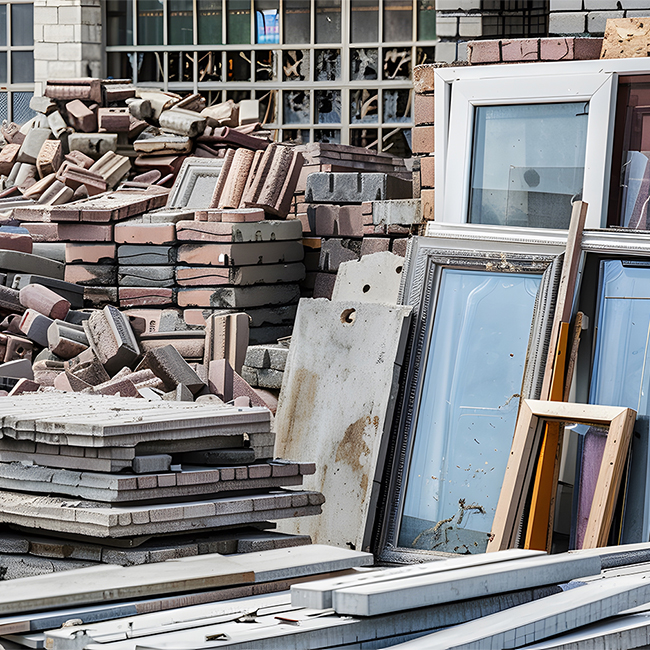
In Luxembourg, annual waste production is 9.2 million tons, equivalent to 14.6 tons per inhabitant, nearly three times the EU average amount. The construction sector, which has generating 7.5 million tons of waste in 2020 in Luxembourg, accounts for more than 80% of the waste released annually. It is also the sector that consumes the most resources. Those trends are also observed over European countries.
These figures confirm that the construction sector is a major sector of the Luxembourg economy. Then it presents a wide range of opportunities to implement optimal and sustainable resources management and must be a driving force in this transition, based on the principles of circular economy.
The entire construction value chain is concerned and must be involved in the transition, which is further stimulated by the current context (energy crisis, criticality of natural resources, housing crisis). To be effective and coherent, the transition shall rely on waste prevention but also on the exploitation of urban resources, by scaling up reuse and high-value-added recycling, considering that resource efficiency is always preferable. This requires addressing and removing regulatory, technical and economic barriers, by training and calling up the various actors.
LIST will explore the latest advancements in sustainable construction, in order to facilitate for public and private stakeholders the adoption of the best practices in relation to construction and deconstruction techniques, and waste valorization.
LIST analysis of the regulatory framework and existing models based on circularity principles, will be driven by considering the Luxembourg specific context and its capacities and needs for enhancing resource preservation – including building elements reuse and excavated material prevention, and fostering circular economy principles adoption at the different steps of the loop.
The outcomes of the project are intended to reach policy makers and public authorities, public and private building owners, and the various actors of the construction value chain (architects, engineering offices, contractors, professional associations, private companies) by bringing them support for the implementation of best practices for a more circular management of construction and deconstruction waste.
In particular, best practices for selective deconstruction will be highlighted, and the project will result with awareness raising and recommendations to implement reclamation and reuse of building elements towards public actors. Innovative construction techniques will also be investigated in line with the objective to promote waste prevention through alternative decision (preservation, lifespan extension, etc.) linked to circular and sustainable design.
