

12
employees
30
publications over the last 5 years
17
projects
Water is our most precious resource – we depend on it for drinking, feeding ourselves, and keeping our ecosystems alive. Protecting and monitoring this vital resource means protecting everyone's well-being and health. But how can we ensure that water flowing through our environment, rivers, and taps remains safe? What can this water teach us about emerging chemical and microbiological threats facing our societies?
A meaningful water quality monitoring framework acts as an early warning system: it allows us to detect epidemics before they explode, identify contamination before it spreads, and protect public health proactively rather than reactively.
Infectious diseases continue to pose serious threats to global public health, despite major progress in medicine, vaccination, and sanitation. The forces shaping their spread are deeply interconnected, reflecting the complexity of our globalized world. The rapid movement of people and goods allows pathogens to travel across continents within hours, turning local outbreaks into international crises. Global changes and climate change further intensify risks by altering ecosystems, expanding the geographical range of vectors carrying infectious diseases, such as mosquitoes. Extreme weather events - heatwaves, floods, and storms - not only cause immediate loss of life but also disrupt communities, public health systems, and ecosystems. Simultaneously, rapid urbanization and population growth, particularly in cities with limited infrastructure, create crowded environments where sanitation and access to clean water are insufficient, facilitating the transmission of waterborne and water-related diseases. Adding to these challenges, antimicrobial resistance represents a growing crisis as the overuse of antibiotics in medicine and agriculture practices has led to strains of bacteria that are increasingly difficult to treat, threatening to undermine decades of medical progress.
The complexity of current health threats demonstrates the fundamental interconnection between human, animal, and environmental health. Biodiversity loss increasing the risk of zoonotic infectious diseases, such as COVID-19, highly pathogenic influenza viruses and emerging infections, crossing from animals to humans, remind us of that new global health emergencies are inevitable. This reality underscores the necessity of adopting a One Health approach that recognizes the intricate relationships between human activities, environmental changes, and disease emergence.
Understanding these global challenges provides the context in which our research group operates, guiding the design of innovative solutions at local, regional, and international levels. Our research directly addresses these interconnected threats by developing early detection systems that can identify microbiological risks before they become public health crises. Through this integrated approach, our research contributes to building resilient monitoring frameworks that serve as critical tools for protecting public health in an increasingly complex and interconnected world
Building on this context, the mission of the Environmental Microbiology Group is to translate global health threats into concrete research actions and solutions.
To address these pressing challenges and fill the gaps in current knowledge about these pathogens, we are focusing on two complementary approaches: developing innovative, cost-effective technologies for detection and real-time monitoring, and developing sustainable decontamination technologies to ensure a safe environment for humans, animals and ecosystems.
Beyond research, the group is strongly committed to knowledge transfer and public awareness. Raising understanding of environmental and health risks is seen as essential to prevention, and outreach initiatives are used to engage both citizens and stakeholders. This commitment to sharing knowledge helps make scientific outcomes more impactful and sustainable.
Activities involve both the European and international levels, by strengthening public health capacities in Luxembourg, collaborating across European networks, and engaging in projects that directly involve low- and middle-income countries (LMICs). Many of our outcomes are designed to be scalable and transferable to ensure a broader global impact.
Fully aligned with the LIST missions, the Environmental Microbiology Group is supporting public and private partners (nationally and internationally) in reaching their objectives in terms of positive impact for health and environment as well as economic competitivity and political stability. LIST has been particularly active in bringing together the healthcare and environmental sectors.
Based on a 20-year experience in monitoring environment-borne pathogens, the Environmental Microbiology Group develop innovative sensors, monitoring procedures and data treatment to support decision-making at all stages of the water cycle.
Our work is structured around three observatories:
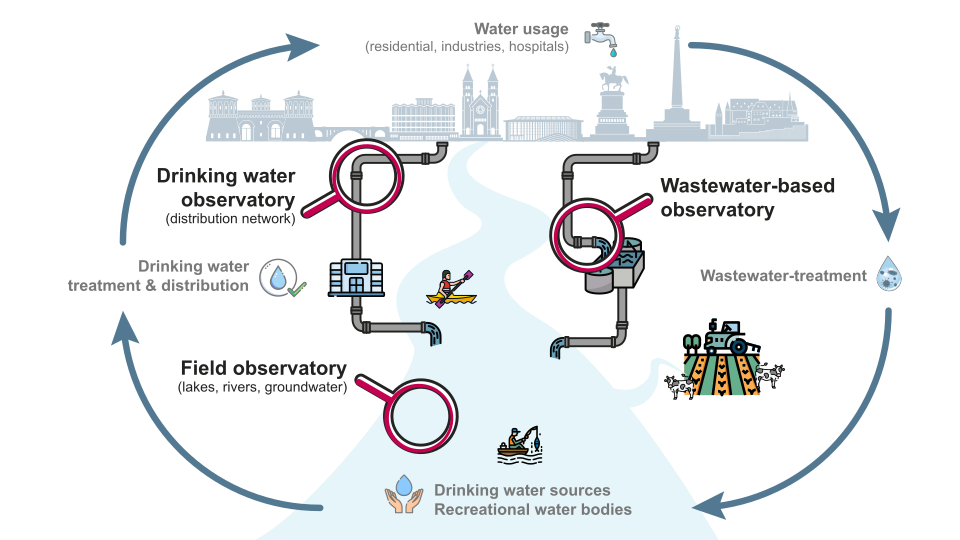
The Environmental Microbiology Group benefits from strong national partnerships and contributes to policy support and decision-making. The team is recognized for its ability to adapt to emerging public health needs and for maintaining a high level of technical expertise across diverse methods. Collaboration plays a central role in our activities, including projects with industrial partners and support for the development and validation of innovative solutions.








Establishment of a permanent wastewater surveillance system for key viral pathogens of concern in Luxembourg
Prevent water pollution by pharmaceuticals
Aptasensors as an emerging and convenient tool to improve the multiplex detection of foodborne viral diseases
Immobilization of lignin nano/microparticles on plasma-modified polymer nanofibers
Janů L., Souawda N., Anand R., Duday D., Medalová J., Collard D., Nečas D., Polášková K., Ryšánek P., Thomann J.S., Janůšová M., Zajíčková L.
International Journal of Biological Macromolecules, vol. 343, art. no. 150226, 2026
Hock L., Luiken R., Valério E., Vargha M., Vierheilig J., Börjesson S., Pitkänen T., Schmitt H.
Euro Surveillance Bulletin Europeen Sur Les Maladies Transmissibles European Communicable Disease Bulletin, vol. 31, n° 3, 2026
Martins Conde P., Bulaev D., Rauschenberger A., Ohnmacht J., Fritz J.V., O’Sullivan M.P., Ancien F., Ghosh S., Tsurkalenko O., Kolodkin A., Satagopam V., Vaillant M., Klucken J., Krüger R., Lorentz V., Bocquet V., Lamine S., Mtimet S., Roland O., Kofanova O., Aouali N., Menster M., Alexandre M., Valenti M., Richard I., Nieser G., Marques G., Contesotto G., Neu F., Soboleva E., Meek C., Coimbra C., Gamio C., Schritz A., Mendibide A., Parrish A., Saracino S., Sega R., Theresine M., Ferrari A., Zamboni T., Weibel E., Weber B., Wauters F., Wang X., Walczak C., Vögele C., Vyas M., Verschueren C., Moreno C.V., Esteves D.V., Turner J., Trung N., Trouet J., Trefois C., Toukourou N., Toll S., Thien H., Stute L., Sokolowska K., Snoeck C., Skrozic A., Simon F., Servais J.Y., Seal S., Schweicher A., Schumacher S., Schröder V., Schneider R., Schmitt C., Schmitt M., Sausy A., Satagopam V.P., Santos B., Sandt E., Rump K., Rommes B., Rodriguez A., Remark L., Meyers G.R., Plesseria J.M., Pirard M.F., di Pinto P., Pexaras A., Perquin M., Penny C., Pavelka L., Pauly L., Pauly C., Ollert M., Olesky C., Ogorzaly L., O’Sullivan M.P., Nicolai B., Nguyen T., Neumann M., Mühlschlegel F., Mériaux S., Munsch M., Mousel A.
Scientific Reports, vol. 15, n° 1, art. no. 37381, 2025