
PollTrail
Influence of anthropogenic emissions and meteorology on health-relevant air pollutants in rural and urban areas of Luxembourg
View more


Enhancing air quality monitoring in Luxembourg through complementary pollutant measurements, mobile particle characterization and Copernicus Atmosphere Monitoring Service (CAMS) data valorisation
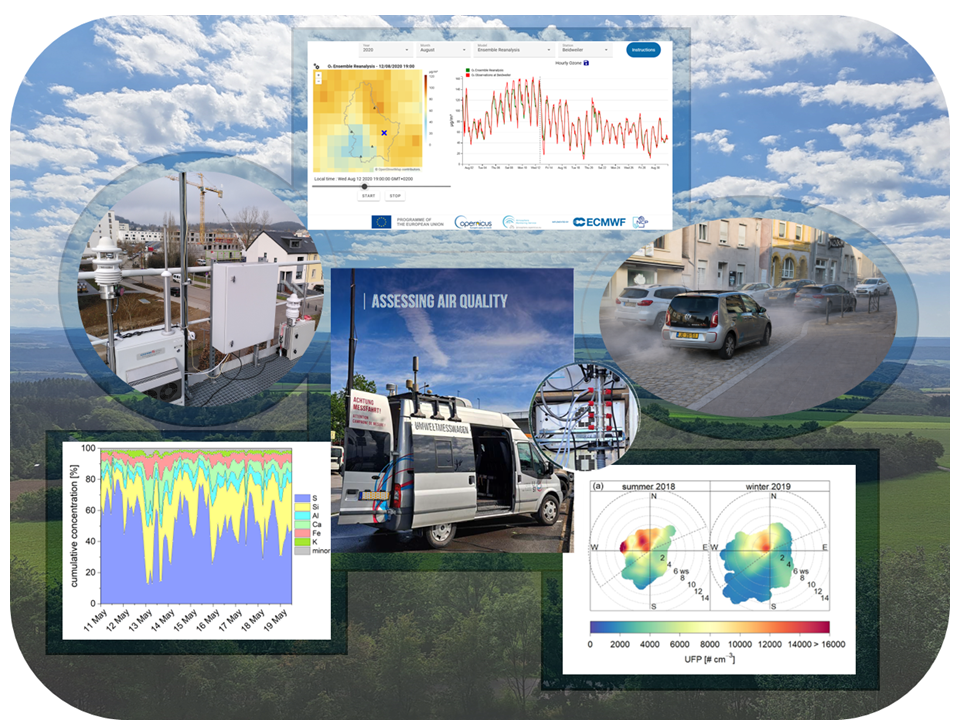
The project addresses a range of policy requirements, scientific needs, and societal drivers in the field of air quality. On the one hand, stricter pollutant limits under the revised Air Quality Directive (EU) 2024/2881 for substances such as PM10 require more accurate characterization of spatial pollution patterns. At the same time, the permanent monitoring network of the Administration de l'environnement (AEV) should be extended to include additional variables such as ultrafine particles (UFPs) and ammonia (NH3), in order to comply with new monitoring obligations. In addition, the contribution of natural and other unidentified contributions to particulate matter concentrations is receiving increased attention. Beyond these regulatory requirements, other drivers further inspired this project. These include the need to make use of spatially resolved data such as from the Copernicus Atmosphere Monitoring Service (CAMS) service tailored to national needs (e.g., the identification of cross-border pollution patterns) and the integration of low-cost sensors to complement existing measurements.
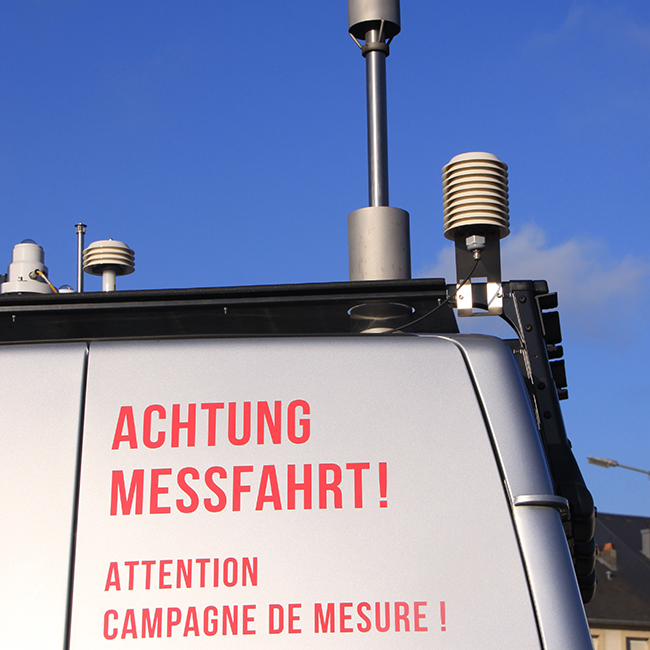
The project delivers innovation and adds value by extending the existing air quality monitoring activities in Luxembourg and applying novel approaches for pollution source attribution. The continuation and extension of the NH3 monitoring network and the long-term measurement of UFPs at Belvaux, combined with meteorological data, represents a valuable dataset for Luxembourg and the Greaer Region. The coupling of UFP temporal variability with meteorological conditions will advance our understanding of local air quality and potential health impacts in urban areas. The project develops automated data processing routines for particle number size distributions, allowing normalization, reducing uncertainties, and ensuring comparability with international datasets. A further innovation is the differentiation of natural PM10 sources, such as soil resuspension, from anthropogenic non-exhaust emissions including brake and tire wear by conducting mobile measurements. The dedicated analysis of Saharan dust events as well as cross-border pollution transport patterns and their impacts on Luxembourg by integrating CAMS data products with local measurement networks in our decision support system (DSS) developed within the SCALER project will enhance the capability of the AEV to comply with the revised Air Quality Directive (EU) 2024/2881.
This project delivers a robust framework to support the implementation of the revised EU Air Quality Directive by expanding the monitoring and analytical capacity for emerging and previously underregulated pollutants in Luxembourg. By integrating long-term measurements of NH3 and UFP with mobile online chemical characterization of PM10, the project enables a more holistic quantification of pollutant sources, atmospheric processes, and exposure relevant to human health. The systematic valorisation of CAMS data within our advanced DSS further strengthens spatial attribution, cross-border pollution transport analysis, and event-based assessments. Together, these elements provide a coherent, policy relevant basis to refine air quality management strategies, and enhance decision making under complex emission and meteorological conditions in Luxembourg.