

14
People
30
Publications in 2024
13
Ongoing projects
3
Service contracts
According to the Global Assessment report released in 2019 by the Intergovernmental Science-Policy Platform on Biodiversity and Ecosystem Services (IPBES), about 1 million animal and plant species are threatened with extinction globally. Human activities are degrading healthy ecosystems and jeopardizing food security, climate resilience, clean air, water and soils, ultimately endangering the foundations of human well-being and quality of life.
In the annual releases of its Global Risks Report, the World Economic Forum reports on how increasingly fragmented landscapes and related geopolitical, environmental, societal and technological challenges are exerting significant pressure on socio-economic stability and progress. Since the first edition of the report in 2006, not only have risks to the environment become more frequent, but the impact of these risks has become more severe. The long-term outlook remains troubling, with biodiversity loss and ecosystem collapse now ranked among the most critical global risks.
Adopted at the 15th Conference of the Parties to the Convention on Biological Diversity (CBD) in 2022, the Kunming-Montreal Global Biodiversity Framework (GBF) provides an outline for the achievement of the United Nations Sustainable Development Goals. The GBF sets goals for 2050 and targets for 2030 – all geared towards achieving the global vision of a world living in harmony with nature by 2050. All signatories committed to translating the GBF into national-level actions. In Luxembourg, this is reflected in the third national plan for nature protection for 2030 (PNPN3). At the European level, the EU biodiversity strategy for 2030 and the Nature Restoration Regulation support the full and swift implementation of the GBF targets.
Long-term time series of observation data are essential to track progress towards biodiversity targets at national and global levels. They provide timely, concise and tailored scientific evidence on the changing state of biodiversity, which is then used to inform policymakers. Biodiversity monitoring schemes aim to generate such time series and are key to assisting stakeholders in making informed decisions about the sustainable management of natural resources.
The Biodiversity Monitoring and Assessment group is a multi-talented team of researchers, engineers and technicians advancing field data collection methods to produce time series that document the spatial and temporal dynamics of living organisms in terrestrial and freshwater ecosystems. As a national hub at the interface between the scientific community and decision/policymakers in Luxembourg, the group conducts data sampling, collection and analysis on various types of organisms to assess their changing conservation status and dynamics. The group also develops and makes use of technology-based approaches for data collection and processing, thereby strengthening knowledge and competences in biodiversity monitoring and assessment across the country.
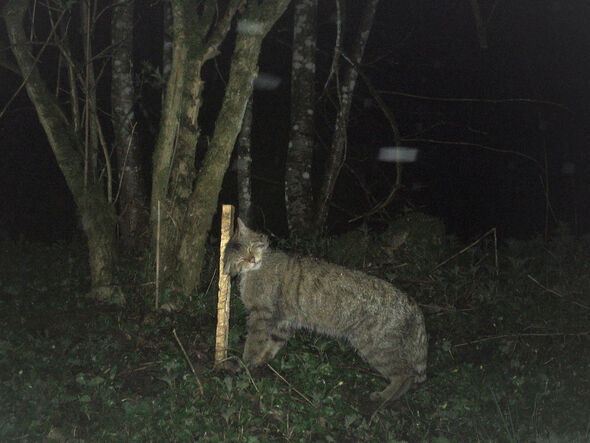

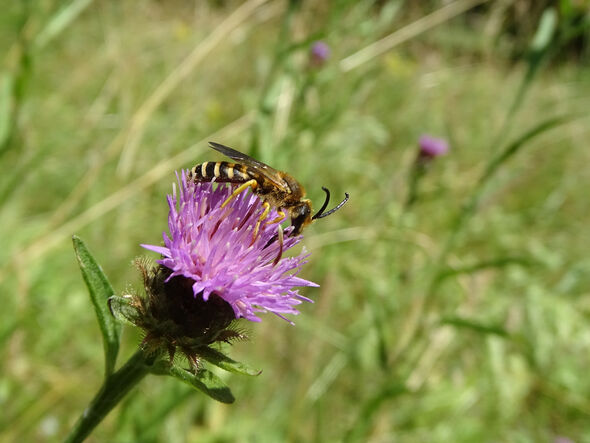
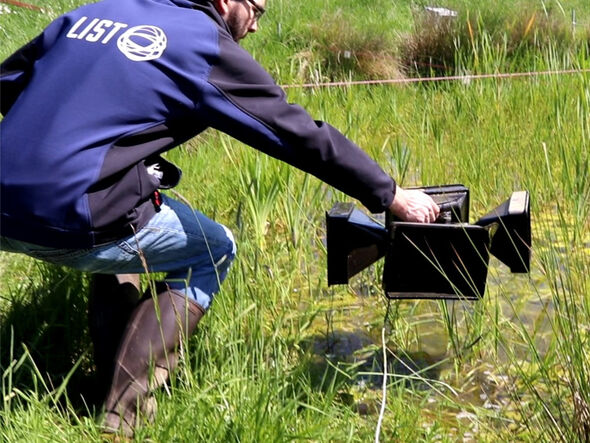
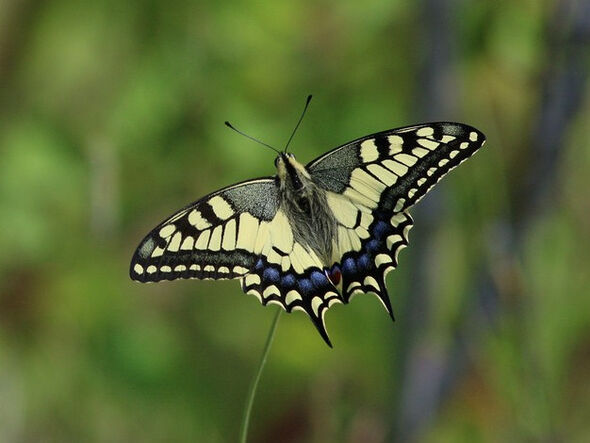
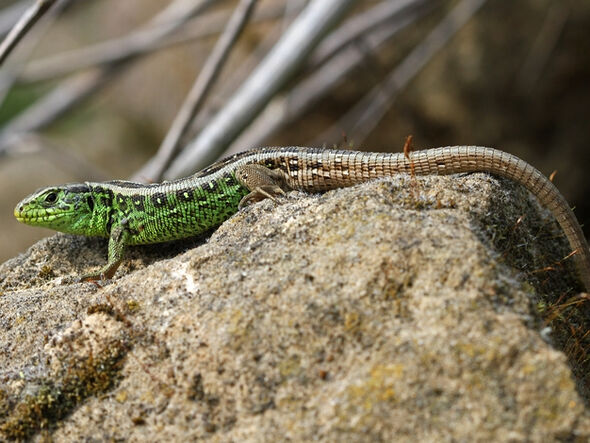
The group has been coordinating the development and implementation of various national-scale biodiversity monitoring schemes in interconnected projects carried out in close collaboration with key stakeholders in Luxembourg and partners across Europe. These initiatives focus on:
Some of these projects have been running for several years, with observations systematically conducted across a stable network of sites. These sites are selected using varying sampling approaches, and data collection protocols are tailored to the specific characteristics of each species or group of species. This structured sampling design and standardized data collection are key to generating reliable time series that serve as robust baseline information to estimate biodiversity changes with powerful statistical methods and in a scientifically unequivocal way.
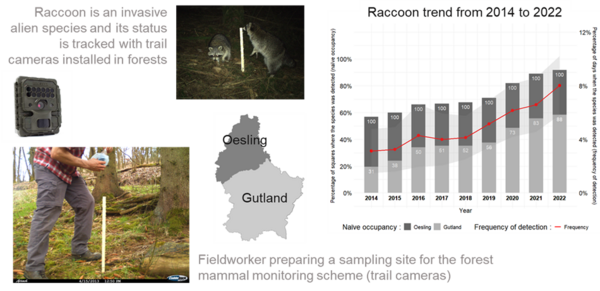
As one of the coordinators of multiple biodiversity monitoring schemes in Luxembourg, the group plays a key role in reporting on changes in the conservation status of selected species. Activities include contributing to red list updates, producing new distribution atlases, warning about the spread of invasive alien species and developing indicators that document the changing state of nature at the national level. These efforts support cross-border collaborations, enabling data and knowledge exchange that provides information on biodiversity status and dynamics at the international level.
Automated hardware/software solutions (e.g. trail cameras and sound recorders) are combined with traditional approaches to increase the spatial and temporal resolutions of time series and improve the detection of little surveyed species. Molecular approaches (e.g. environmental DNA and (meta)barcoding) are implemented to explore cryptic hybridization processes or improve the detection of various species in freshwater ecosystems, such as diatoms or invasive species. Citizens are also increasingly volunteering in a range of monitoring activities across the country.
The group combines field-based research, technological innovation and collaborative actions to strengthen biodiversity monitoring and deliver robust data for science-informed decision-making. This scope of expertise is based around five complementary pillars:











Engaging citizens in the monitoring of wild pollinators in Luxembourg
Assessment of honeybee viruses in wild pollinators in Luxembourg
Monitoring forest mammals with trail cameras in Luxembourg
Bohnet I.C., Hager G., Rellensmann T., Hardy C., McHugh N.M., Ablinger D., Bagnoni V., Banks G., Beyer M., Duijvestijn L., Franck P., Janeckova K., Kaasik R., Martin Y., Moonen A.C., Salehi A., Sánchez-García C., Schoone M., Scott C., Travnicek J., van Rijn P., Varas G., Veromann E., Warlop F., Wohlmuth M.L., Begg G.S.
Agricultural Systems, vol. 233, art. no. 104644, 2026
<p>Beauger A.; Allain E.; Voldoire O.; Theveniaud E.; Gassama N.; Wetzel C.E.</p>
<p>Botany Letters, vol. 172, no. 1</p>
<p>Valérie Peeters, Luc Ector, Carlos E. Wetzel</p>
<p>Office Français de la Biodiversité</p>